A photographic diary by Raju Subramani
HAMPI
Where Stone Still Speaks
A journey through an empire preserved in stone, faith, wilderness and human memory.
Enter the ruins
00 — Prologue
Hampi was once the imperial capital of Vijayanagara — a city shaped by temples, markets, royal enclosures, water systems and ceremonial avenues that stretched across a boulder-strewn landscape unlike any other.
At its height in the 15th century, Vijayanagara was among the largest cities in the world. Then, in 1565, it was destroyed in a single military defeat.
Today its rulers are gone. But the landscape is not silent. Stone, worship, wildlife and human memory continue to inhabit what the empire left behind.
The approach to Hampi begins before the ruins — it begins with a tower you see from a distance, framed by everything that came after the empire fell.
01—The Living City
A Temple Framed by Time
The Virupaksha Temple has been in continuous use for over a thousand years. While the Vijayanagara empire rose and fell around it, the temple kept its priests, its rituals and its devoted visitors. It predates the capital city that made Hampi famous — and it outlived it.
Seen through the shadowed corridor, the tower does not look like a relic. It looks like something that still needs to be approached carefully, with intention.
Hampi does not reveal itself all at once. It asks you to enter slowly.
The natural dark frame of the corridor transforms the tower into something still being discovered.
To walk through Hampi without knowing its history is to walk through a story without understanding which chapter you are in.
Four moments that shaped a civilisation
Pre-imperial
Sacred Origins
Hampi was established as a sacred centre around the Virupaksha temple long before Vijayanagara rose to power.
14th–16th century
Imperial Capital
Vijayanagara became one of the largest cities in the world, with temples, markets and royal enclosures spreading across the boulder landscape.
1565
Battle of Talikota
The allied Deccan sultanates defeated Vijayanagara, and the imperial city was systematically destroyed and abandoned.
1986
UNESCO Heritage
The Group of Monuments at Hampi was inscribed as a UNESCO World Heritage Site, recognising its outstanding universal value.
History is not only about dates. It is about how civilisations revealed themselves through what they built — and what they chose to borrow from those around them.
Lotus Mahal · Zenana Enclosure
02—Architecture of Encounter
The Lotus Mahal
Kamal Mahal · Chitrangini Mahal · Zenana Enclosure
What you are looking through is not simply a corridor. Each arch in this photograph is shaped like an inverted lotus bud — the cusped form that gives the building its name. The structure stands in the Zenana Enclosure, the walled private quarter within Hampi's Royal Centre.
The Lotus Mahal is two storeys tall, raised on an ornamental granite basement and supported by 24 columns. Its nine arched bays on the ground floor create natural cross-ventilation — a deliberate design for the heat of the Deccan plateau. Eight pyramidal towers rise at the corners and one larger tower marks the centre, referencing the stepped superstructure of Dravidian temples.
The material is not stone — it is brick and mortar finished in lime plaster, which gives the arches their warm, sculptural colour. The arch form comes from Islamic architecture. The towers come from Hindu temple tradition. Together they make something that could only have been built by Vijayanagara.
Early British survey maps from 1799 label this building a "council chamber" — suggesting Krishnadevaraya used it for meetings with his closest ministers. It is one of the few structures at Hampi that survived the 1565 destruction largely intact.
Civilisations often reveal their strength through what they are willing to learn from one another.
Step inside any hall, and the architecture becomes intimate again — not monumental, but personal. Each surface holds a separate conversation.
03—Stories in Stone
Every Pillar Was a Page
The sculptors of Vijayanagara did not separate structure from story. A pillar was not simply a pillar. It was a vertical manuscript — deities at the top, guardians in the middle, animals and ornamental life at the base, all arranged according to a cosmological logic that would have been immediately legible to a 15th-century worshipper.
The monument becomes more powerful when the visitor stops measuring its size and begins reading its surface.
A Ganesha figure occupies the upper register — one carved page of a much longer architectural manuscript.
Pull back, and the singular pillar reveals its place within a hall. The hall reveals its place within a civilisation.
At a certain moment, the sculptor looked upward and understood that the ceiling was as sacred as anything below it.
04—Sacred Geometry
The Ceiling Was Never an Afterthought
Hampi's ceilings are not decorated — they are composed. The star pattern in this photograph was created by corbelling square stone slabs at rotating angles, each layer turning precisely to form an octagonal opening that terminates in a single circular centre.
This is not decoration applied to architecture. This is architecture that is the devotional act — the ceiling becomes a mandala visible only to those who stop and look up.
Stone was used not only to enclose space, but to control how a person looked, moved and felt within it.
A geometry that required no mortar — only precision, patience and belief.
Deeper inside the temple complex, where the light barely enters, the stone holds its most private conversations.
05—Within the Chamber
Protected by Darkness, Reached by Light
These two photographs show the same type of chamber from two distances — first from the entrance, then from inside. The shift is not just spatial. As you move closer, the geometry of the ceiling becomes dominant, and the deity below recedes into the dark base of the composition.
The chamber is designed this way deliberately. Light enters from a single overhead opening, touching the roof first. The deity waits at the bottom — lit only once your eyes have fully adjusted. You are not supposed to see it immediately.
The architecture itself controls the act of discovery.
Two distances. Two relationships to the same space — and the same deity.
Step back outside and the scale changes completely. Hampi does not keep everything intimate. Some of its presences were built to dominate an entire landscape.
06—Monumental Divinity
Power Without a Kingdom
The Narasimha monolith was commissioned in 1528 by the Vijayanagara king Krishnadevaraya — one of the greatest rulers in south Indian history. The sculpture, carved from a single boulder, rises nearly seven metres. It was built to be seen from a great distance.
Krishnadevaraya died six years after commissioning it. His empire was destroyed less than four decades later. The monolith remained.
The empire lost its throne.
Its guardians kept theirs.
But scale was never Hampi's only language. Some of its most enduring moments are small, precise and still attended — every single day.
07—Continuity
A Shrine Held by Water
This linga shrine sits in a shallow tank whose water rises and falls with the seasons. The flowers in this photograph were placed that morning. They will be replaced tomorrow. The linga has been receiving flowers since long before the Vijayanagara empire was founded.
The photograph holds two forms of time together: stone that measures millennia, and devotion that must be offered again, each single day, to remain real.
The stone remains.
The offering must always be made again.
The formal city — its armies, its merchants, its processions — is long gone. But the ruins have not been left without residents.
Visual Interlude
The New Residents
Hampi today is shared between archaeologists, pilgrims, tourists — and the animals who were here before any of them arrived and appear to have no intention of leaving.
The Court Has Changed
Grey langurs have occupied the Hampi ruins for as long as anyone can remember. These two have chosen the stone elephants at the temple entrance — a position of some symbolic authority. The elephants were placed there to mark a sacred threshold. The monkeys are unaware of this and are entirely comfortable with it.
No formal coronation was recorded.
The Roofline Committee
Alexandrine parakeets nest in the cracks and ledges of Hampi's stone structures. These three have positioned themselves at different levels of the same cornice, as though assessing a structural concern that requires several perspectives before any conclusion is reached.
Three observers. One cornice. Several unrecorded opinions.
A Small Feast in a Large Empire
The Indian palm squirrel is perhaps Hampi's most ubiquitous resident. This one has found something — a fragment of something — among the granite boulders and holds it with both paws as though it is the most important thing in the ruins. At this particular moment, it probably is.
The smallest resident received the largest dining hall.
Before the animals, before the visitors, before the archaeologists — there was simply what stayed when everything else left.
08—After the Empire
When the Builders Left
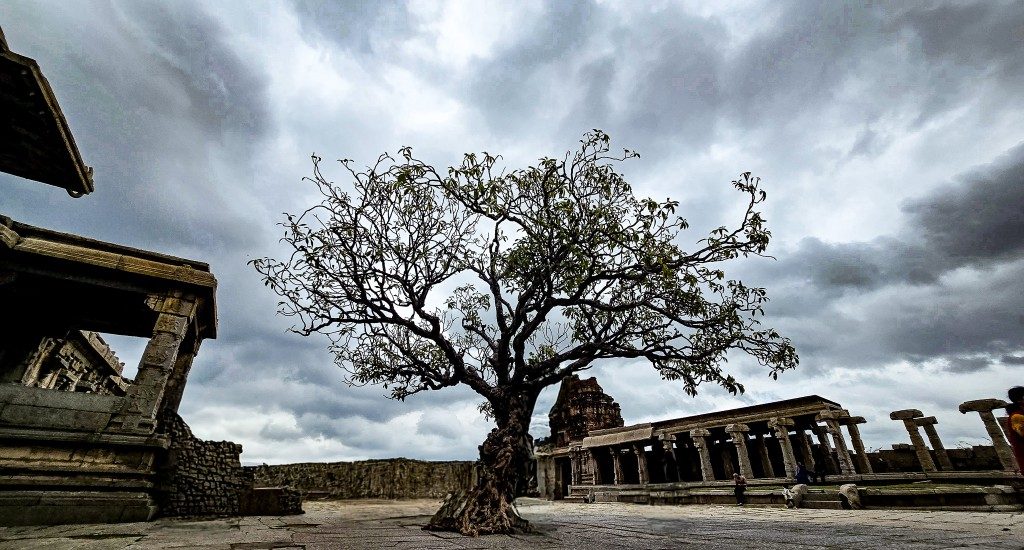
This tree stands in the main courtyard of the Vitthala temple complex — one of Vijayanagara's grandest religious sites. After 1565, the complex was abandoned. At some point after the empire fell, this tree took root in the courtyard. It has been growing there for centuries.
Nature did not preserve Hampi by keeping it untouched. It entered the city. Roots found gaps between stones. Rain blackened walls. The tree grew where processions once moved. It does not know this, and it does not need to.
What history abandoned, the landscape continued to inhabit.
The empire is absent. The tree remains — and it brought the entire sky with it.
Nature adapted to Hampi over centuries. But one presence that never needed to adapt — because she never left.
09—The Living Memory
Saratha Amma
More Than Forty Years in the Service of Hampi
Saratha Amma did not speak of Hampi as a distant archaeological site. She spoke of it the way a person speaks of their home — with ownership, with affection and with an unmistakable, protective pride.
For more than forty years she has served this landscape. She has watched tourists arrive and leave. She has watched monuments slowly change under the pressure of time, weather and footfall. She has watched generations of schoolchildren pass through the same corridors she first entered as a young woman.
Her raised hand was not simply a gesture toward a structure. It carried an instruction: look carefully at what stood here, understand what it cost to build it, and do not reduce this place to a collection of broken stone just because the people who built it are no longer living.
Through her, Hampi became more than a historical site. It became a memory carried by a living person — warm, specific, and irreplaceable.
Some people explain history. Some protect it.
Saratha Amma appears to have spent a lifetime doing both.
Closing Reflection
What Hampi Left With Me
I arrived looking for monuments.
I found a civilisation distributed across pillars, courtyards, deities, water, wildlife and human memory.
The monkeys, parakeets and squirrel reminded me that the ruins are still inhabited.
Saratha Amma reminded me that heritage does not survive through stone alone.
Empires remain in what they built, in what people remember and in those who refuse to let either disappear.
Hampi still speaks.
The responsibility is to keep listening.
Photographed and documented by Raju Subramani
Hampi, Karnataka — October 2025