WEEKWISE
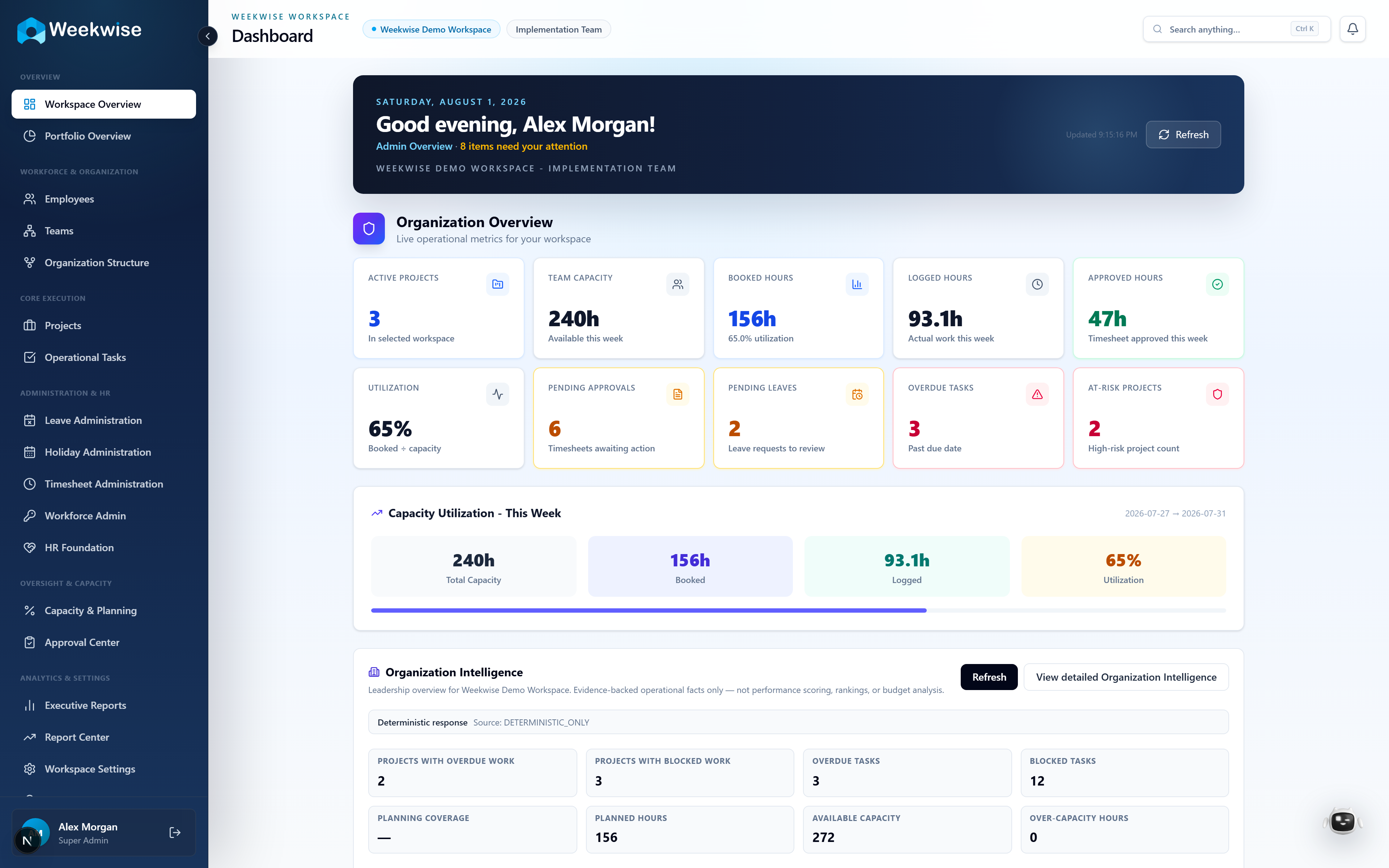
A connected Work Intelligence platform exploring how teams can plan, execute, record, approve, and learn through one operational system.
One connected foundation for projects, planning, capacity, timesheets, leave, approvals, and governed AI — so planned work, availability, actual effort, and outcomes share the same context.
Product Type
Enterprise SaaS · Work Intelligence
Domain
Delivery Operations & Capacity
Stage
Working foundation · Active exploration
Core Approach
Operating foundation before AI autonomy
WEEKWISE,
AT A GLANCE.
The problem, the product direction, the working system, and where the exploration stands today.
THE CHALLENGE
Planning, capacity, tasks, time, leave, and approvals live in separate tools — the full operational picture is hard to see.
WHAT I EXPLORED
How one connected system could hold weekly planning, execution, capacity, and operational evidence in a shared rhythm.
THE PRODUCT DIRECTION
Build the operating foundation first, then introduce AI around real workflows, permissions, evidence, and human confirmation.
CURRENT STAGE
An active independent exploration with a working system, an evolving intelligence layer, and a validation roadmap.
RESEARCH STRUCTURE,
AT A GLANCE.
Category analysis, product comparison, and workflow investigation — to find where a distinct operating model could sit.
50
Providers benchmarked
Compared across features, pricing, market fit and positioning.
5
Adjacent product categories
Project management, HRMS, time tracking, resource planning and PSA/PPM.
4
Primary user experiences
Administrator, Project Owner, Team Lead and Employee.
1
Connected weekly operating loop
Planning, execution, actuals, approvals and intelligence.
Project management
Jira, Asana, monday.com, ClickUp
HRMS and workforce platforms
Keka, greytHR, Darwinbox, Zoho People
Time tracking
Harvest, Toggl, Clockify
Resource planning
Float, Resource Guru, Runn
PSA and enterprise PPM
Kantata, Planview, Workfront, ServiceNow

Delivery Ops · Work Intelligence
Category Positioning
Positioned between Delivery Operations and Work Intelligence.
Key finding
Each category solved one part of the workflow well, but delivery work, availability, planned effort, and approved actuals stayed fragmented. Weekwise should not become another generic task tool.
ORGANISATIONS HAD TOOLS FOR EVERY ACTIVITY—BUT NO SHARED OPERATIONAL TRUTH.
Project tools held tasks. Spreadsheets held capacity plans. HR systems held leave. Time trackers held actual effort. Approvals lived in email and chat. Reports were manually assembled from all of them.
Managers could see activity, but they still struggled to answer four basic questions:
- What did the team commit to?
- Who was genuinely available?
- What was actually completed?
- Where is intervention required now?
The problem was not tool availability.
The problem was decision fragmentation.
Fragmented tools
Weekwise
One governed workspace
Planned work, availability, actuals and outcomes — same context.
Fragmented truth
Six systems. Zero shared operating picture.
Projects
Tasks only
Spreadsheets
Capacity
HRMS
Leave
Time trackers
Actuals
Email / chat
Approvals
Reports
Manual stitch
A task alone is not enough to manage delivery
A task becomes operationally meaningful only when it is connected to:
- A responsible owner
- Planned effort
- Available capacity
- Employee availability
- Actual effort
- Progress evidence
- Approval state
- Delivery outcome
This changed the product from a feature collection into a connected operating model.
“The opportunity was not to build a better task board. It was to connect commitments with operational reality.
ONE WORKSPACE CONNECTING WORK, PEOPLE, AND EXECUTION EVIDENCE.
Weekwise was structured around connected product layers rather than isolated modules. Each layer supports the same weekly operating cycle.
Capacity, Commitments, & Availability
Establish realistic weekly commitments before work begins by combining workload bookings with leave-adjusted team availability.
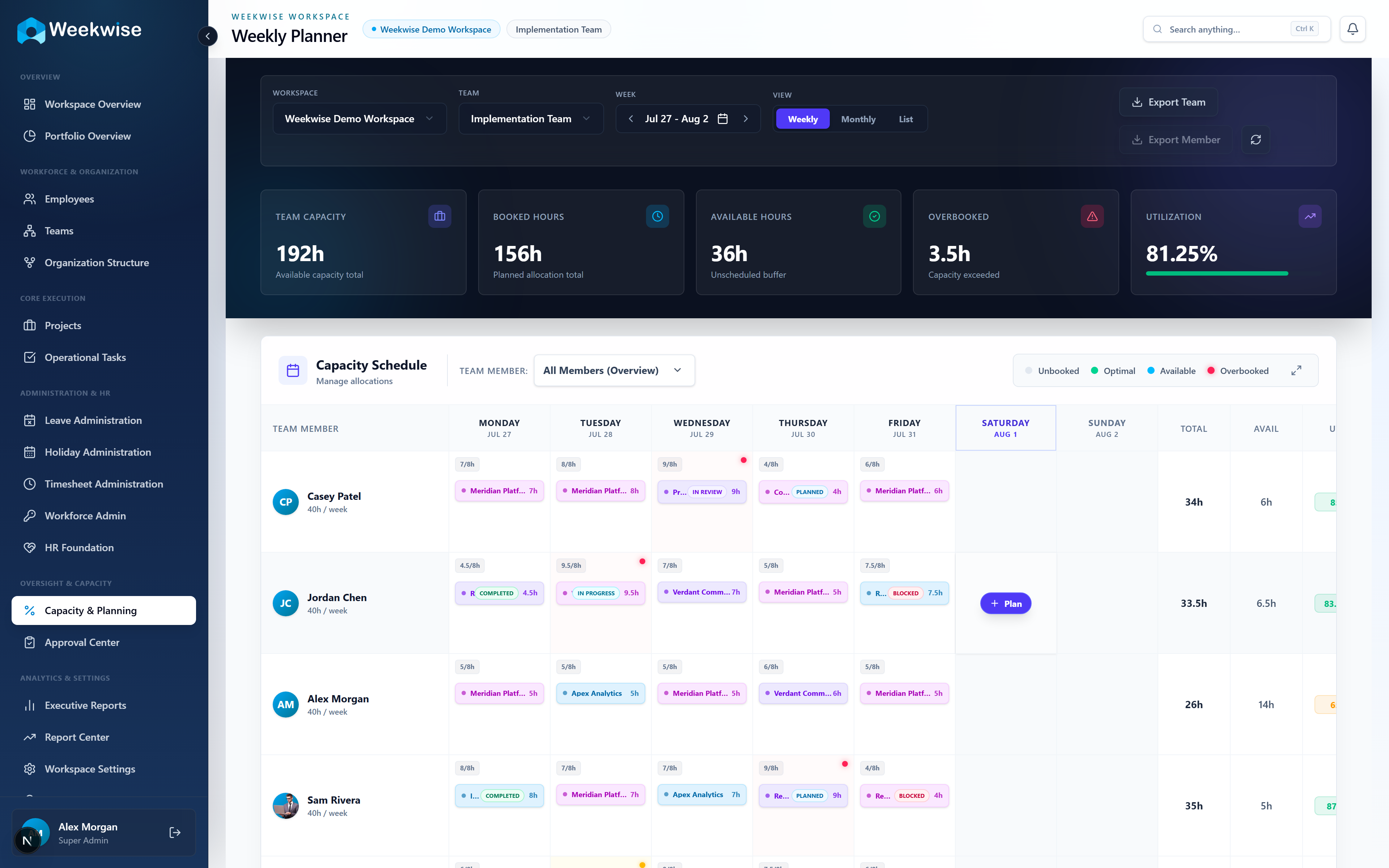
Capacity, bookings, remaining availability, and overload stay visible in the same weekly plan.
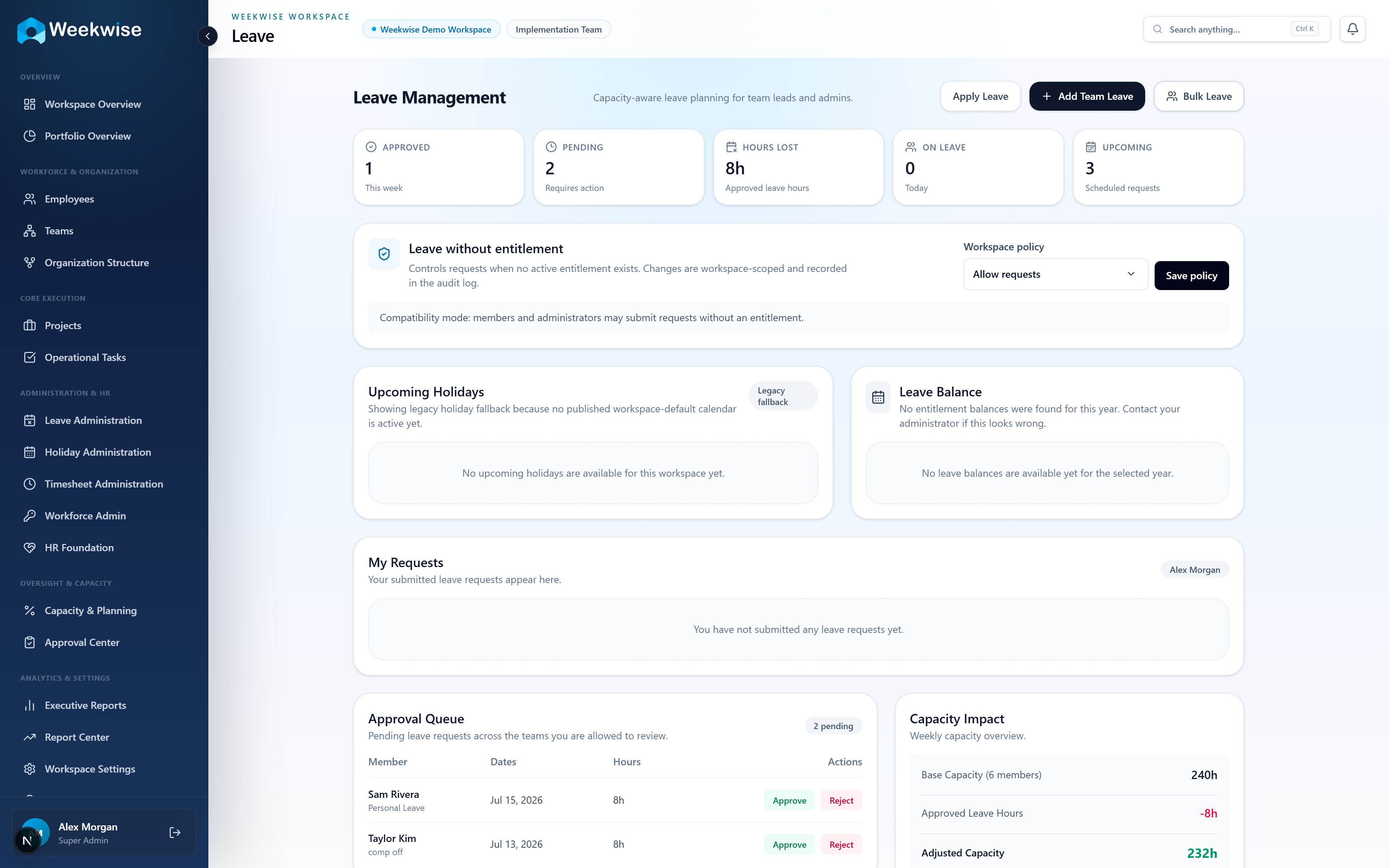
Approved leave is reflected as a visible reduction from base to adjusted team capacity.
Execution Workspace & Traceable Effort
Connect active task execution with explicit ownership, milestone progress, and traceable actual effort across weekly timesheets.
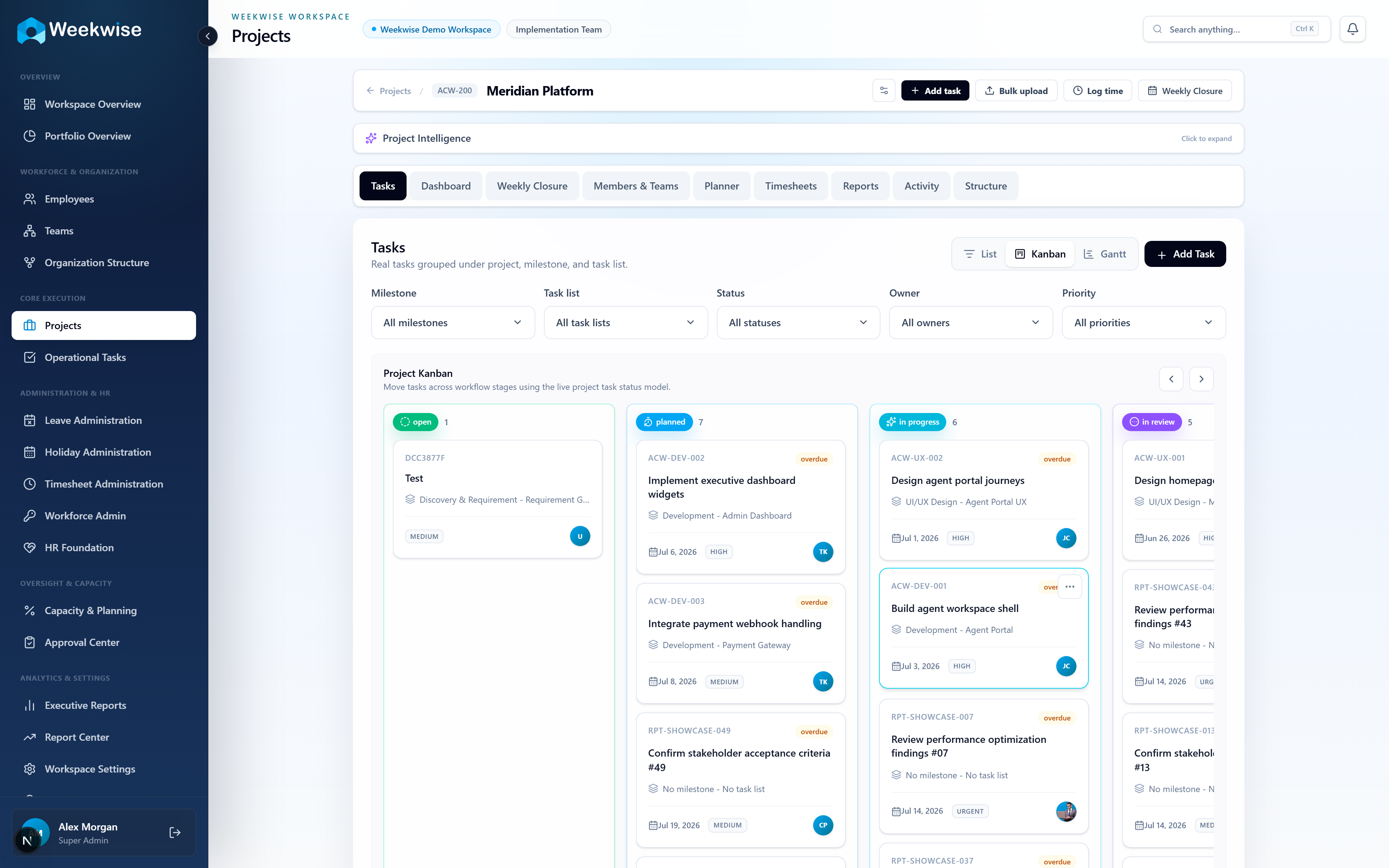
Execution stays connected to ownership, planned effort, and progress evidence.
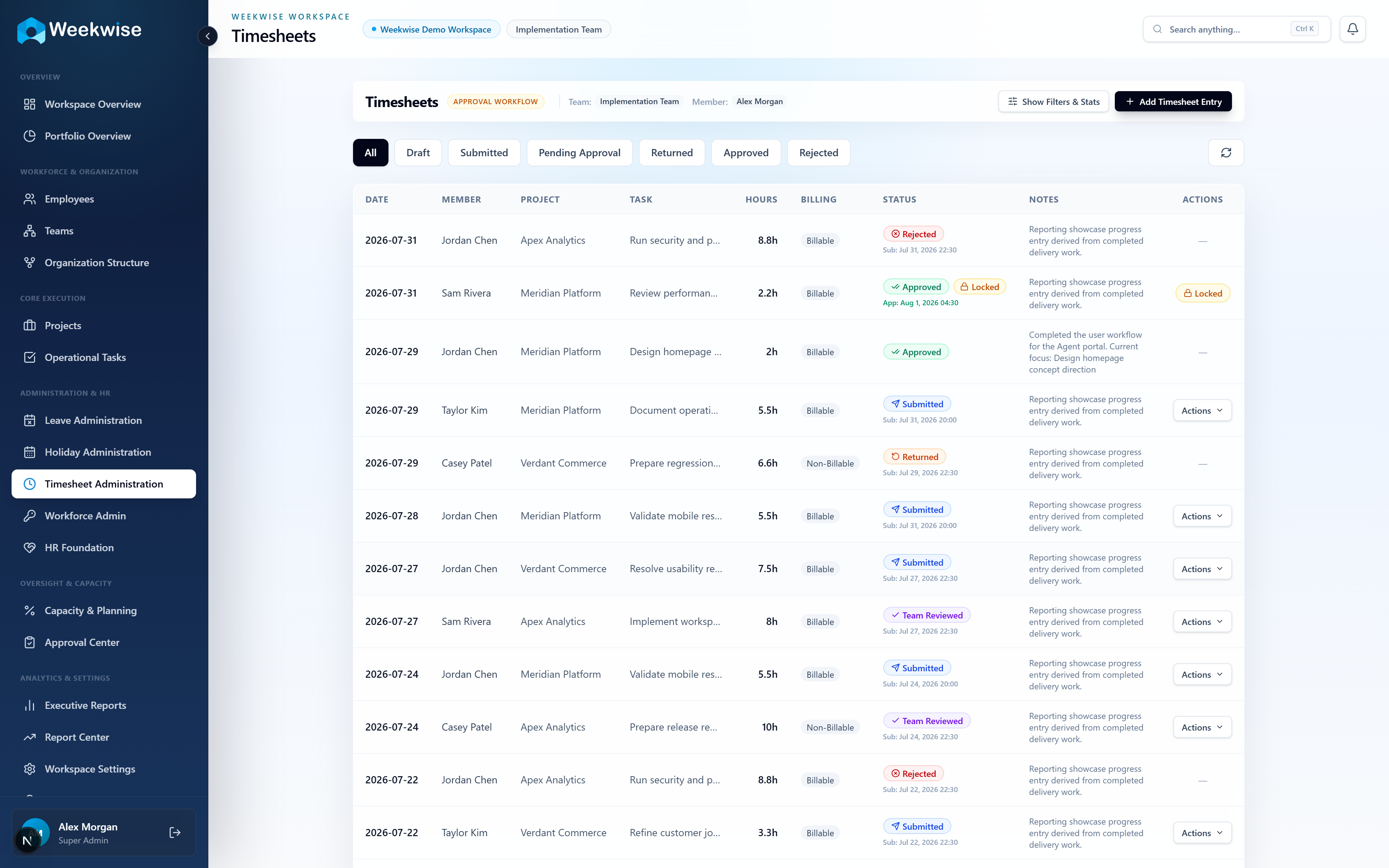
Actual effort stays traceable through submitted, returned, reviewed, and approved states.
Controlled Approvals & Grounded Intelligence
Turn weekly closures into governed decisions, backed by source-labelled operational facts and human confirmation before AI actions.
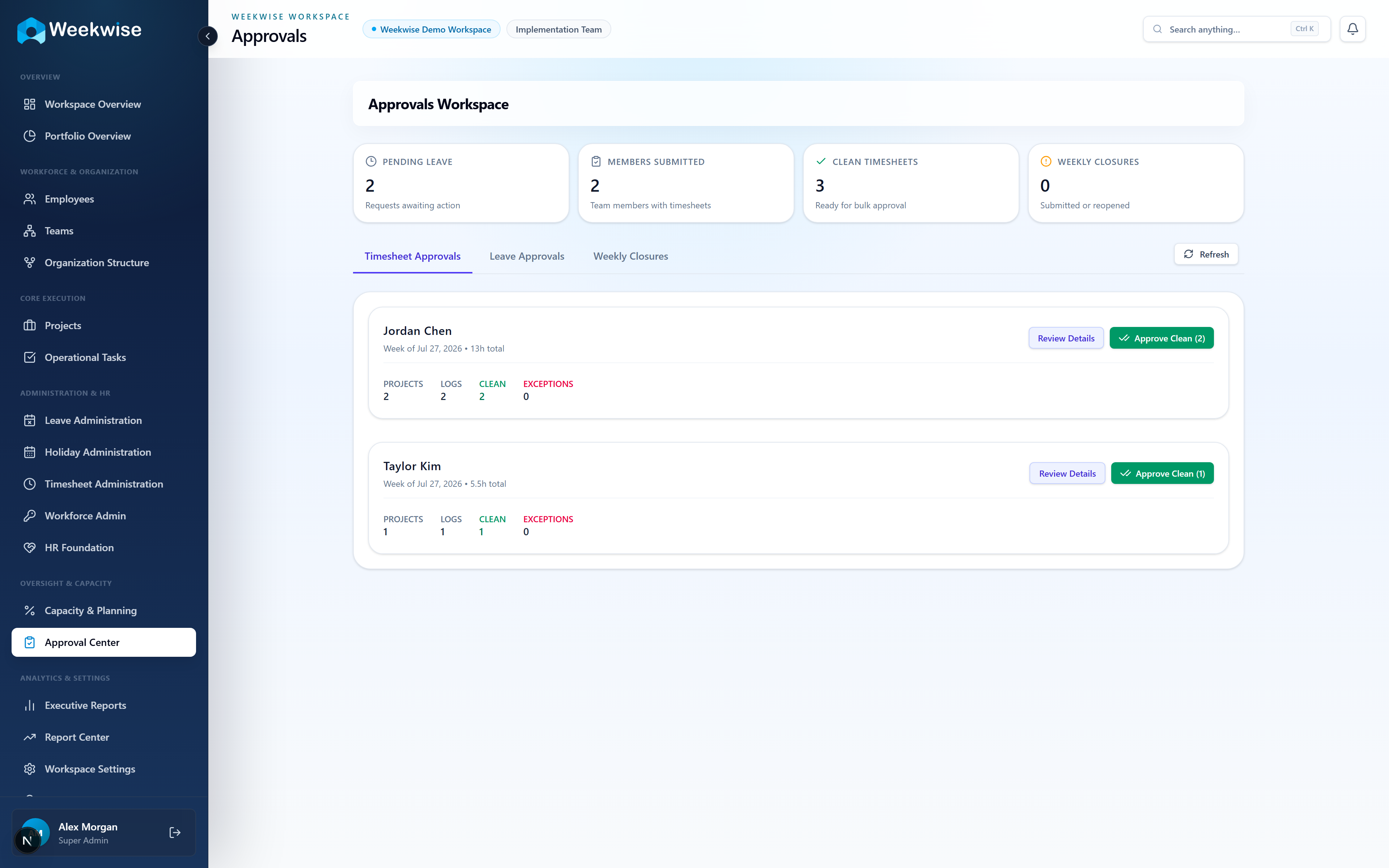
Review queues turn timesheets, leave, and weekly closures into controlled decisions.
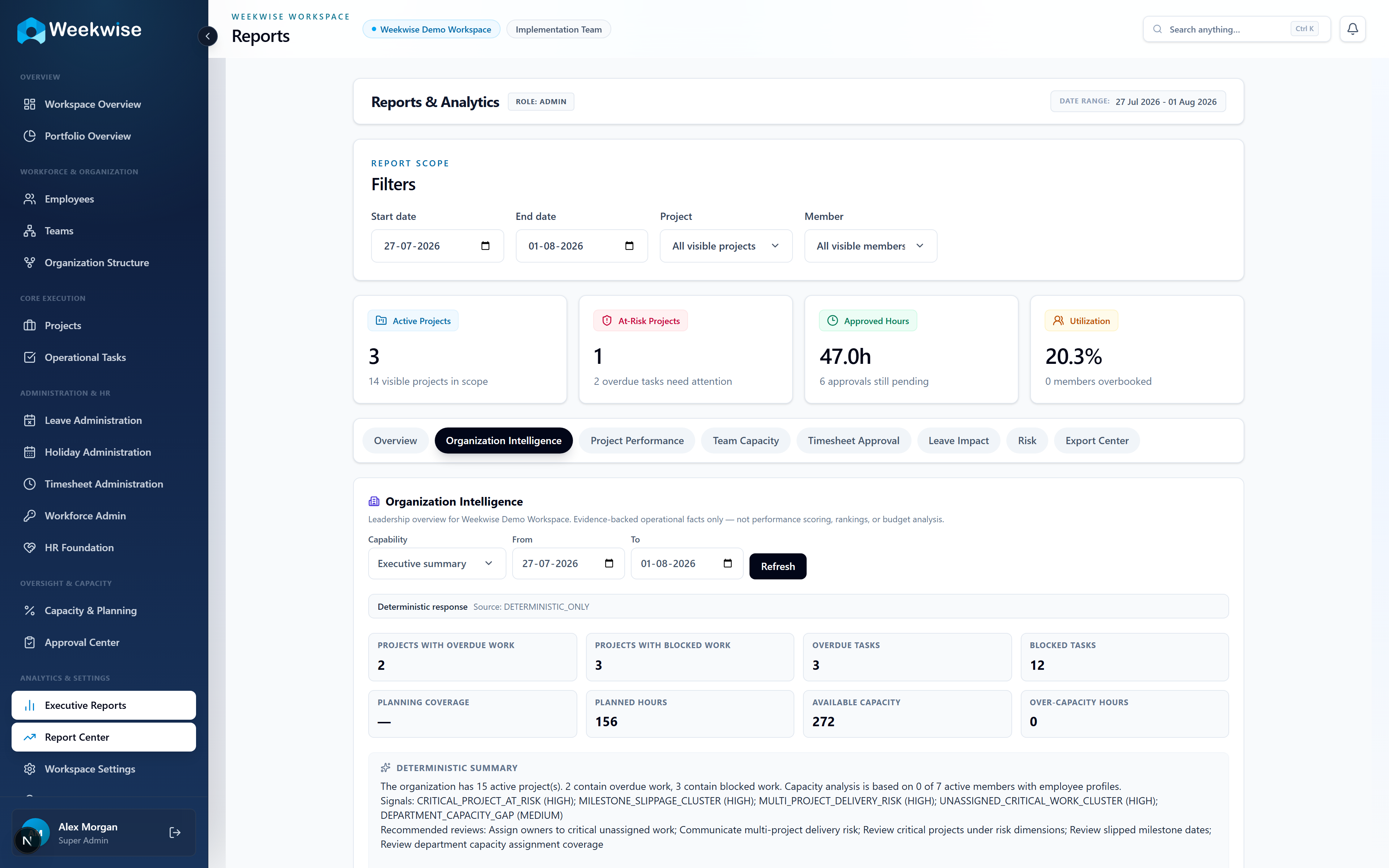
Intelligence stays grounded in visible operational facts and source-labelled evidence.
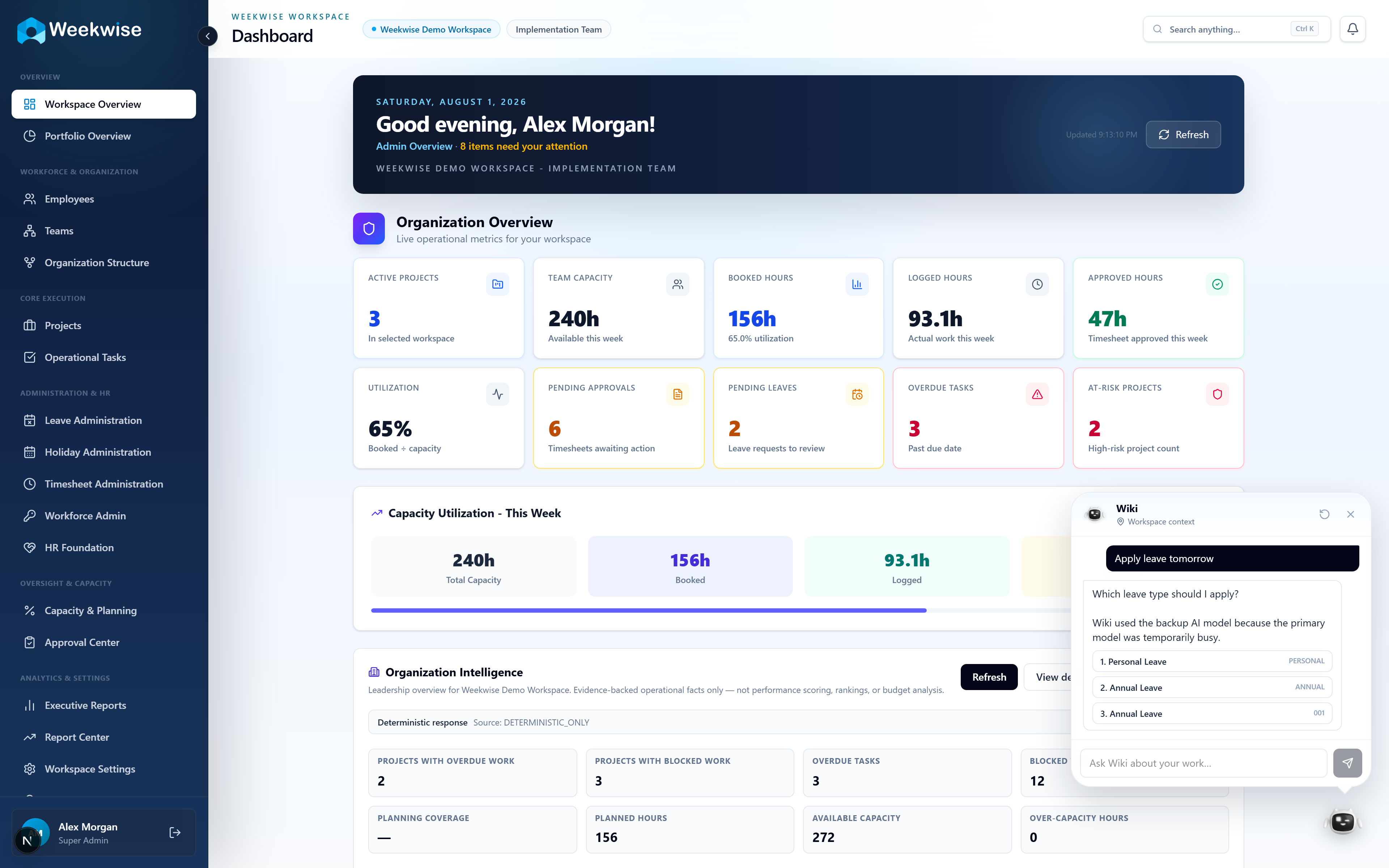
Natural language starts the workflow; ambiguity is resolved before any protected action can proceed.
DECISIONS THAT SHAPED THE PRODUCT.
Every major decision balanced context, reason, trade-offs, and product consequences to protect domain integrity.
In scope
Leave as capacity signal—not HRMS expansion.
Out of scope
Deliberate exclusions that protect product focus.
Leave is capacity data—not an HR add-on
Leave looked like an HR expansion until capacity accuracy made the case: a teammate can look fully booked in a task system while approved leave leaves only 24 of 40 hours realistic.
Leave and holiday workflows stay because they make delivery planning trustworthy. Payroll and broader HCM stay out.
The purpose was not to build an HRMS. It was to make capacity realistic.
Approved leave is reflected as a visible reduction from base to adjusted team capacity.
Weekly closure turns activity into accountability
Task status shows current activity, but it does not preserve what was committed, what changed, or why unfinished work moved forward.
Weekly closure was introduced to create a repeatable review point for completed outcomes, blockers, carry-forward, and planning variance.
The week became both the operating rhythm and the future intelligence dataset.
Architectural Trade-offs & Product Judgements
Decision & Rationale
A weekly cadence is short enough for operational correction and long enough for meaningful commitments.
Trade-off & Consequence
The product is less optimized for teams operating purely through daily micro-sprints without weekly capacity commitments.
Judgement lens
Every major call balanced speed, trust, and scope integrity.
- Prefer operational truth over feature breadth
- Prefer authority clarity over AI novelty
- Prefer modular speed over premature microservices
ONE PRODUCT,
SHAPED THROUGH FIVE
CONNECTED DISCIPLINES.
Research, product direction, experience design, technical architecture, and AI governance shaped the same system — not five separate tracks.
Research & Strategy
Market context, user needs, category positioning, product direction, and validation assumptions.
Product Systems
Workflows, policies, lifecycle states, priorities, business rules, and acceptance logic.
Experience Design
Information architecture, role-based journeys, interaction patterns, usability, and clarity.
PRACTICE
Connected Product Practice
Technical Architecture
APIs, data relationships, permissions, integrations, operational boundaries, and system behaviour.
AI Governance
Use cases, evidence, authority boundaries, confirmation, grounding, auditability, and responsible execution.
AI tools accelerated research, implementation, review, debugging, and testing. What to build, why it should exist, and how it should behave stayed human.
TRUSTED AI BEGINS
WITH AUTHORITY DESIGN.
The important questions were about evidence, permissions, confirmation, accountability, and who kept final authority — not only prompts or models.
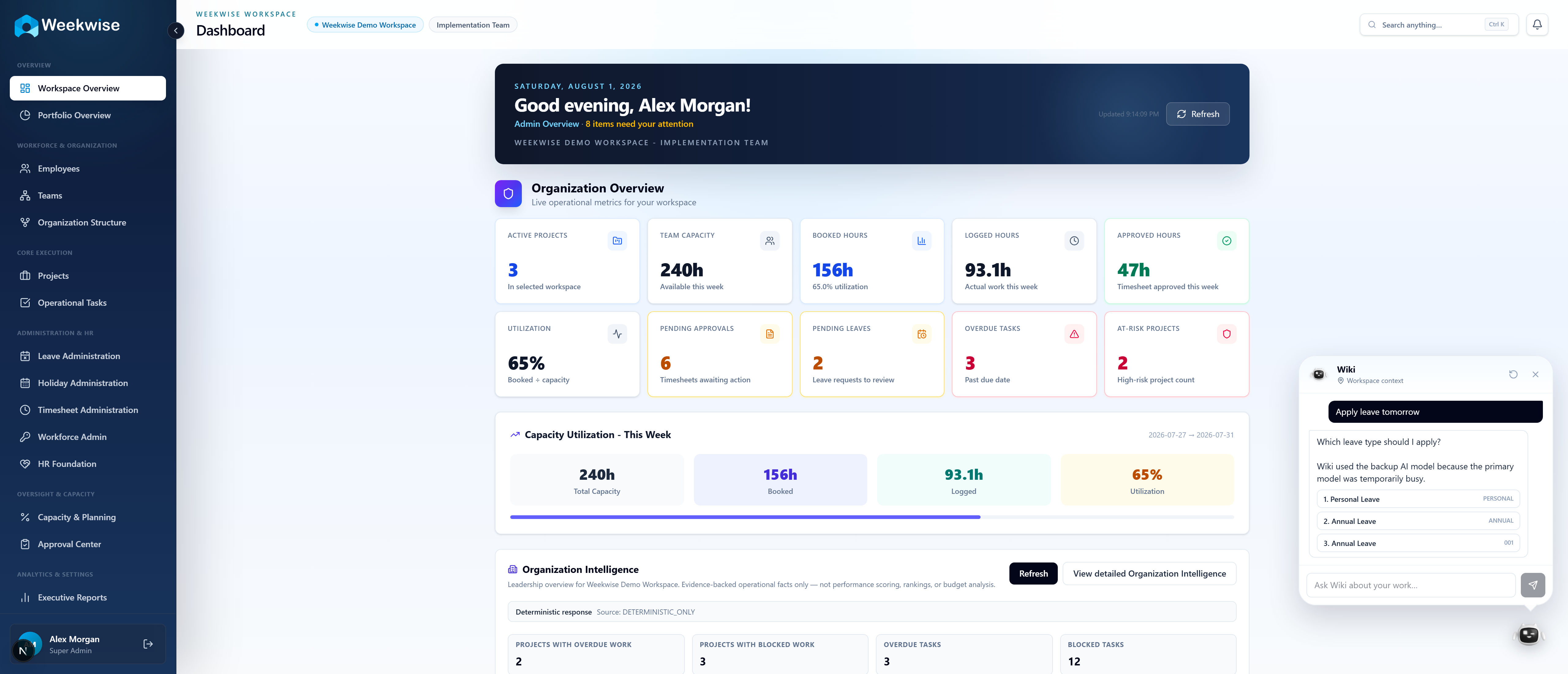
The assistant resolves intent and missing details before a protected action can be proposed.
AI Guide Walkthrough
Four layers of trusted AI — tap a chip to explore
Layer 01
Draft AI
Generates editable task descriptions, progress updates and weekly summaries.
Authority
Nothing becomes authoritative until the user accepts it.
Nothing becomes authoritative until the user accepts it.
Shared foundation
PermissionsDeterministic dataBusiness rulesAuditabilityHuman control“The model interprets language. The product remains the authority.
Flexible understanding. Deterministic execution.
Supporting example: “Apply leave tomorrow” still requires date resolution, leave type, duration, balance validation, policy checks and approval routing.
Choice
Require confirmation before protected mutations
Cost
One additional interaction
Benefit
Transparency, control, lower error risk and stronger enterprise trust
FROM MARKET MODELLING
TO A WORKING SYSTEM.
The product moved through research, product definition, experience design, technical architecture, implementation, testing, and iteration as one connected process.
Research and Strategy
Product and UX
AI-assisted Development
Infrastructure and Validation
A WORKING PRODUCT
FOUNDATION,
STILL EVOLVING.
Weekwise is an active product exploration. What exists today is a connected and testable product foundation; adoption, commercial performance, and organisational outcomes remain to be validated.
Connected operating model
Projects, planning, capacity, timesheets, leave, approvals and reports operate within one workspace context.
Multi-role enterprise experience
Administrators, Project Owners, Team Leads and Employees receive different visibility and actions.
Governed AI actions
Natural-language requests are mapped to controlled intents, validated and executed through deterministic services.
Evidence-backed intelligence
Operational FactPacks are calculated before AI explanation.
Provider-independent AI operations
Providers, models, workloads and fallback configurations are manageable without permanent vendor lock-in.
Automated test suite
Critical authentication, permission, project, planner, timesheet, leave and invitation workflows are covered through end-to-end testing.
A PRODUCT IS NOT SUCCESSFUL
BECAUSE IT CONTAINS
MANY FEATURES.
North Star
Weekly Plan Reliability
The percentage of planned weekly work that results in valid completed outcomes and approved actual effort within the same operating cycle.
Planning quality
- Capacity coverage
- Leave-adjusted allocation
- Planned versus actual effort
Execution
- Completion reliability
- Overdue-work rate
- Carry-forward rate
Governance
- Timesheet compliance
- Approval turnaround
- Closure completion
AI assistance
- AI workflow completion
- Draft acceptance
- Correction rate
- Confirmation cancellation
- Repeated assistant usage
- Grounding coverage
Measurement framework for pilot validation — not achieved results
BUILDING WEEKWISE
CHANGED HOW I THINK
ABOUT AI PRODUCTS.
INTELLIGENCE STARTS WITH CONNECTED DATA
AI becomes useful only when planning, capacity, execution, evidence, and authority are connected. Disconnected tools produce fragmented answers.
TRUSTED AI BEGINS WITH AUTHORITY DESIGN
The product must define who can act, what requires confirmation, and how decisions remain explainable. The most important questions are about evidence and accountability.
POLICY-DRIVEN INTELLIGENCE NEEDS ARCHITECTURE
Operational AI cannot be reliably added as a final interface layer. Showing users fewer, more relevant actions requires deeper context and permission design.
AI-ASSISTED DEVELOPMENT INCREASES SPEED—NOT PRODUCT ACCOUNTABILITY
The tools can accelerate implementation, but product judgement, problem boundaries, trade-offs, and quality remain human responsibilities.
“Successful enterprise AI begins before the model. It begins with reliable facts, clear workflows, and trusted authority boundaries.
FROM PRODUCT FOUNDATION
TO MARKET VALIDATION.
Next validation priorities — not already delivered
Pilot validation
Test the complete weekly operating loop with IT services, professional-services, and project-led organizations.
Product instrumentation
Measure activation, planning reliability, approval cycles, closure, and AI usage as one connected funnel.
Selective integrations
Prioritize integrations that remove duplicated work rather than adding connectors for marketing breadth.
Predictive intelligence
Build portfolio-level capacity, delivery-risk, and forecasting capabilities only after sufficient operational history exists.
THE STRONGEST OUTCOME WAS NOT THE NUMBER OF FEATURES.
It was creating one coherent product system around a clear objective:
“Help organisations plan realistically, execute clearly, and make better decisions from trusted operational evidence.”